


































































































































































Table of Contents
ToggleRealistic Morning Routine for Productivity: 10 Simple Habits That Work
Author: RVLNSV PRASAD
Updated On: September 2026
About Us
Author Bio
Editorial Policy
Contact Us
Introduction
A productive morning does not have to begin at 4:00 or 5:00 a.m. It does not require a complicated checklist, expensive supplements, a cold shower, or an hour of meditation.
A realistic morning routine for productivity should do something much simpler. It should help you wake up properly, protect your sleep, get some daylight, move your body, decide what matters most, and create enough uninterrupted time to begin the day well.
The science also suggests that the most useful morning habits are not necessarily the most dramatic ones.
Sleep, light exposure, physical activity, regular schedules, and sensible routines all interact with the body’s internal clock and daily functioning. The National Heart, Lung, and Blood Institute explains that light and darkness are important signals for the body’s circadian system, while regular sleep and wake times can help keep the sleep-wake cycle aligned. NIH: How Sleep Works and Your Sleep-Wake Cycle
This matters because many popular morning-routine articles start with productivity and work backward toward health. A better approach is to start with health and build productivity on top of it.
I have also learned that a routine is easier to maintain when it is realistic. A routine that looks impressive on paper but is difficult to repeat will eventually become another source of pressure.
The goal is not to create a perfect morning.
The goal is to create a morning you can actually repeat.
Quick Answer
The best morning routine for productivity is one that fits your sleep schedule and daily responsibilities. A practical routine can include waking at a consistent time, getting natural light, drinking water according to thirst, doing a few minutes of movement, avoiding immediate digital distractions, choosing one important task, and starting focused work.
You do not need to wake extremely early to become productive.
Adults generally need at least seven hours of sleep, and maintaining a regular sleep schedule is an important part of healthy sleep. CDC: Sleep and Heart Health
So, if waking at 5:00 a.m. means cutting your sleep short, an earlier alarm may work against the very productivity you are trying to improve.
What Makes a Morning Routine Productive?
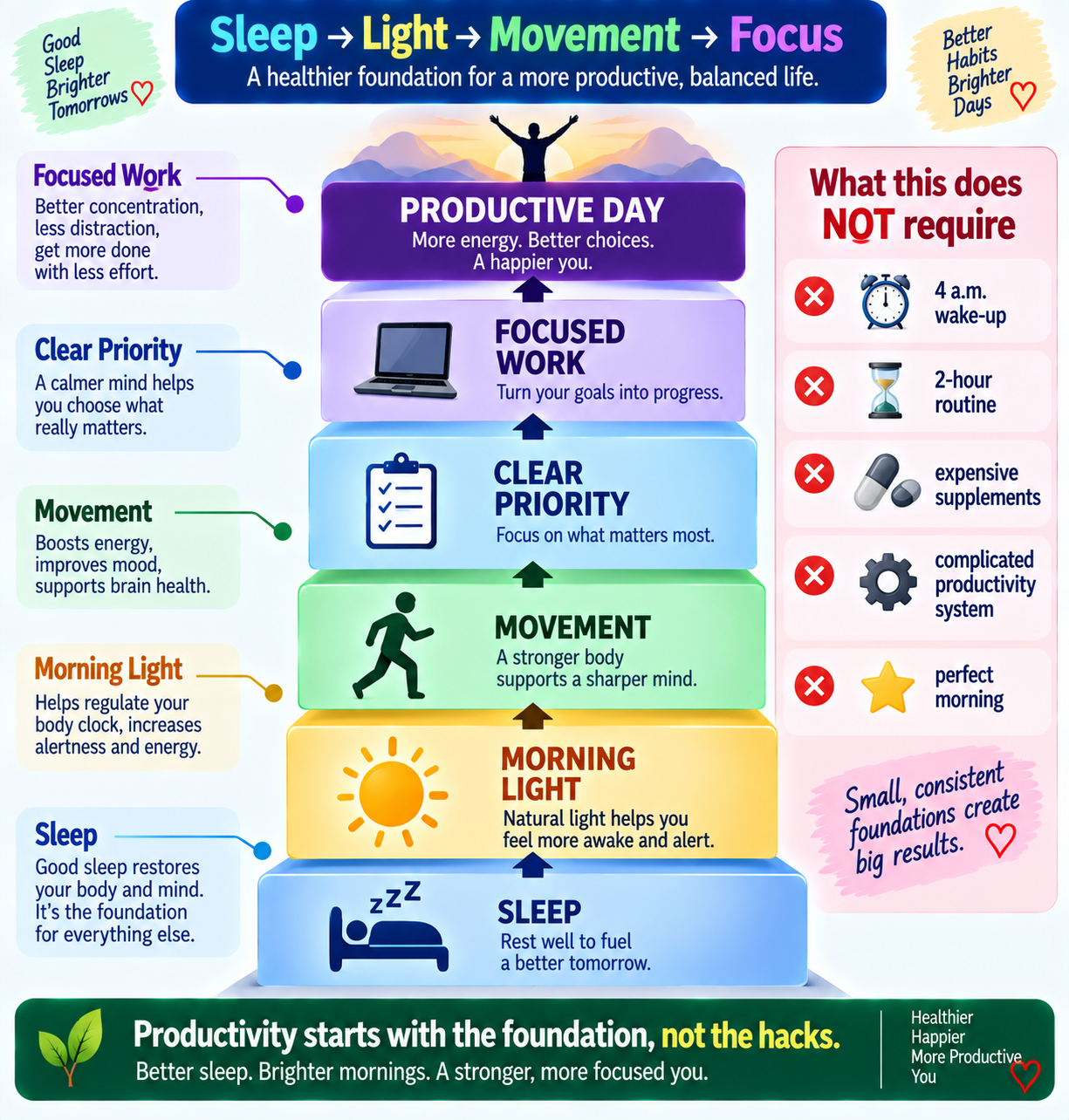
A useful routine has four jobs:
| Goal | Practical morning action |
|---|---|
| Wake up properly. | Get out of bed at a consistent time. |
| Support alertness. | Get daylight and move your body |
| Protect attention. | Delay unnecessary notifications and social media. |
| Create progress. | Choose one important task and begin it |
You can add breakfast, meditation, exercise, journaling, or reading if those activities genuinely help you.
However, they should support your routine rather than become requirements that make the routine difficult.
This is an important distinction.
A productive morning is not necessarily a long morning.
It is a morning that helps you use your available time intentionally.
1. Protect Your Sleep Before Optimizing Your Morning
The first habit actually starts the night before.
If you consistently sacrifice sleep so that you can wake earlier, your morning routine has been built on the wrong foundation.
Sleep affects daytime functioning, and the CDC recommends that most adults get at least seven hours of sleep each night. It also recommends maintaining a regular sleep schedule and getting natural light earlier in the day. CDC: About Sleep and Your Heart Health
That means your first productivity question should be:
“Am I getting enough sleep?”
before asking:
“What time should I wake up?”
A simple night-before preparation
Before bed, you can:
- Decide what tomorrow’s most important task will be.
- Put necessary items where you can easily find them.
- Prepare your clothes.
- Reduce unnecessary late-night screen use.
- Set a realistic wake time.
- Give yourself enough opportunity to sleep.
The NIH explains that artificial light in the evening can interfere with the body’s normal sleep-wake signals, while light and darkness help regulate the circadian system. NIH: How Sleep Works
This is one of the most overlooked morning habits for productivity because the quality of tomorrow morning is partly determined by tonight’s choices.
2. Wake Up at a Time You Can Maintain
You do not need to copy somebody else’s wake-up time.
If you naturally function well with a 6:30 a.m. wake time, there is little reason to force yourself to wake at 4:30 a.m. simply because a successful person recommends it.
Your schedule should account for:
- bedtime
- work or school
- commuting
- family responsibilities
- exercise
- sleep needs
- your natural sleep pattern
A consistent schedule can be more useful than constantly changing your wake time.
The NIH notes that the body’s circadian clock responds to environmental cues including light and darkness, while regular routines can help align sleep and wake timing. NHLBI: Circadian Rhythm Disorders Treatment
People-first insight
If your routine requires you to behave like someone with a completely different lifestyle, it probably needs to be redesigned.
A parent, student, shift worker, office employee, and business owner may all need different mornings.
That is normal.
3. Get Morning Light
Morning light is one of the most useful parts of a healthy morning routine, yet it is often overshadowed by productivity tricks.
Light is one of the strongest environmental signals controlling the circadian system. The NIH explains that light received through the eyes helps tell the brain that it is daytime and helps coordinate the body’s sleep-wake timing. NIH: How Sleep Works and Your Sleep-Wake Cycle
You do not need to stare directly at the sun.
Instead, consider:
- opening the curtains after waking
- sitting near a bright window
- going outside
- taking a short morning walk
- having breakfast outdoors when practical
Natural outdoor light is generally much brighter than typical indoor lighting.
Morning light can be particularly important for people whose sleep schedule has drifted later. Clinical guidance for circadian rhythm disorders includes appropriately timed morning light as one treatment approach, although the timing and intensity depend on the specific disorder. NHLBI: Circadian Rhythm Disorders Treatment
Important: Do not look directly at the sun. If you have an eye condition or have been advised to limit bright light exposure, follow your healthcare professional’s advice.
4. Move Your Body for a Few Minutes
You do not need a full workout every morning.
A few minutes of movement can be enough to transition from sleep to activity.
Try:
- a brisk walk
- gentle mobility exercises
- yoga
- bodyweight movements
- light resistance training
- stretching
- climbing stairs
The important point is that morning exercise does not have to be extreme.
A large 2025 umbrella review and meta-meta-analysis covering 133 systematic reviews, 2,724 randomized trials, and more than 258,000 participants found that exercise was associated with improvements in general cognition, memory, and executive function. The researchers also found that effects were generally larger with low- and moderate-intensity exercise than with no exercise. PubMed: Exercise, cognition, memory and executive function systematic review
That does not mean a five-minute morning walk will suddenly make you highly productive.
It means regular physical activity is a reasonable part of a lifestyle that supports cognitive health.
A 5-minute movement option
If you are short on time:
- Walk for two minutes.
- Perform gentle shoulder and hip movements.
- Do a few controlled bodyweight squats if appropriate for you.
- Take several relaxed breaths.
- Begin your day.
If you have a medical condition, injury, or exercise limitation, choose an activity appropriate for your situation.
5. Drink Water Without Treating It as a Miracle Productivity Hack
You may see claims that drinking water immediately after waking “flushes toxins,” “wakes up your organs,” or dramatically increases energy.
Those claims go too far.
Water is important for normal body function, but there is no special morning glass that automatically turns an ordinary morning into a highly productive one.
Drink according to your needs and thirst, with greater attention to hydration during hot weather, exercise, or illness.
You can drink plain water when you wake up if you enjoy the habit.
Lemon is optional.
There is no need to turn it into an elaborate detox ritual.
This is a useful example of a broader principle:
A simple healthy habit does not need an exaggerated claim to be valuable.
6. Keep Your Phone From Taking Over the First Part of Your Morning
This may be one of the most practical productivity changes you can make.
You wake up and check WhatsApp, followed by email, Instagram, and YouTube, until a news notification catches your attention.
Before you have decided what matters, somebody else’s priorities have already entered your attention.
The solution does not have to be “never use your phone in the morning.”
Instead, create a small protected period.
For example:
First 20–30 minutes: no unnecessary notifications or social media.
Use your phone if you genuinely need it for:
- an alarm
- navigation
- an emergency
- an important family message
- a necessary work responsibility
The goal is not digital purity.
It is protecting attention.
Recent research on adult sleep has also continued to examine the relationship between bedtime screen use and sleep health, reinforcing why digital habits should be considered across the entire day rather than treated as a separate productivity issue. PubMed: Bedtime screen use and adult sleep health
7. Choose One Important Task
A common productivity mistake is creating a morning plan containing 15 tasks.
That often creates the feeling of being busy without identifying what actually matters.
Instead, ask:
“If I complete only one important thing today, what should it be?”
Write the answer down.
For example:
Finish the first draft of my article.
or:
Complete the most important work assignment before lunch.
or:
Study one chapter without checking social media.
The goal is not to ignore everything else.
It is to establish a clear priority.
The one-task rule
Try this sequence:
Important task → focused work → smaller tasks
rather than:
Notifications → email → social media → messages → random tasks → important work
The difference is that the first approach gives your most valuable task protected attention.
8. Create a Small Focused-Work Block
Once you have selected your priority, give it a defined block of time.
It might be:
- 20 minutes
- 30 minutes
- 45 minutes
- 60 minutes
Choose a duration that fits your schedule.
During that period, remove obvious distractions.
Close unnecessary browser tabs.
Silence nonessential notifications.
Keep only the materials required for the task.
You don’t need a complicated productivity system.
You need a clear task and enough uninterrupted time to work on it.
This is especially useful for people working from home because the boundary between morning preparation and actual work can easily disappear.
9. Eat a Balanced Breakfast If It Works for You
Breakfast does not have to be mandatory for every adult.
Some people prefer eating soon after waking, while others do not.
The evidence on breakfast and cognition is more nuanced than many productivity articles suggest.
A systematic review of breakfast and cognitive performance found some evidence of benefits for certain memory outcomes, but results for attention and executive function were less consistent. PubMed: Effects of Breakfast and Breakfast Composition on Cognition in Adults
Another systematic review found insufficient consistency to make firm conclusions about the exact breakfast composition that produces better cognitive performance. PubMed: Breakfast Composition and Cognitive Performance Systematic Review
So rather than declaring one “best productivity breakfast,” focus on a balanced eating pattern.
Practical breakfast ideas
Try combinations such as
| Breakfast | Simple additions |
|---|---|
| Eggs | Vegetables + whole-grain toast |
| Yogurt | Fruit + nuts or seeds |
| Oats | Fruit + nuts + yogurt |
| Idli | Sambar + vegetables |
| Dosa | Sambar + vegetable side |
| Poha | Peanuts + vegetables |
| Upma | Vegetables + protein-rich side |
If you exercise in the morning, your food needs may differ depending on workout intensity, duration, and personal tolerance.
The goal is not to find a magical “brain food.”
It is to build an overall nutritious diet.
10. Build the Routine Around Consistency, Not Perfection
This may be the most important habit of all.
A morning routine becomes useful when you can repeat it.
Research on health-behavior habit formation shows that habits develop over time and that automaticity varies considerably between people and behaviors. There is no scientifically reliable rule saying every habit becomes automatic in exactly 21 days or 30 days. PubMed: Time to Form a Habit Systematic Review and Meta-Analysis
A 2026 systematic review and meta-analysis also examined how consistency of context relates to physical-activity habit strength, supporting the practical idea that repeating behavior in a stable context can help habit development. PubMed: Context Consistency and Habit Strength Meta-Analysis
That gives you a simple strategy.
Instead of saying:
“Every morning I will meditate, exercise for an hour, journal, read, cook a perfect breakfast and complete three hours of deep work.”
Start with:
“After I wake up, I will open the curtains and go outside for a few minutes.”
Once that feels normal, add another habit.
A Realistic 30-Minute Morning Routine
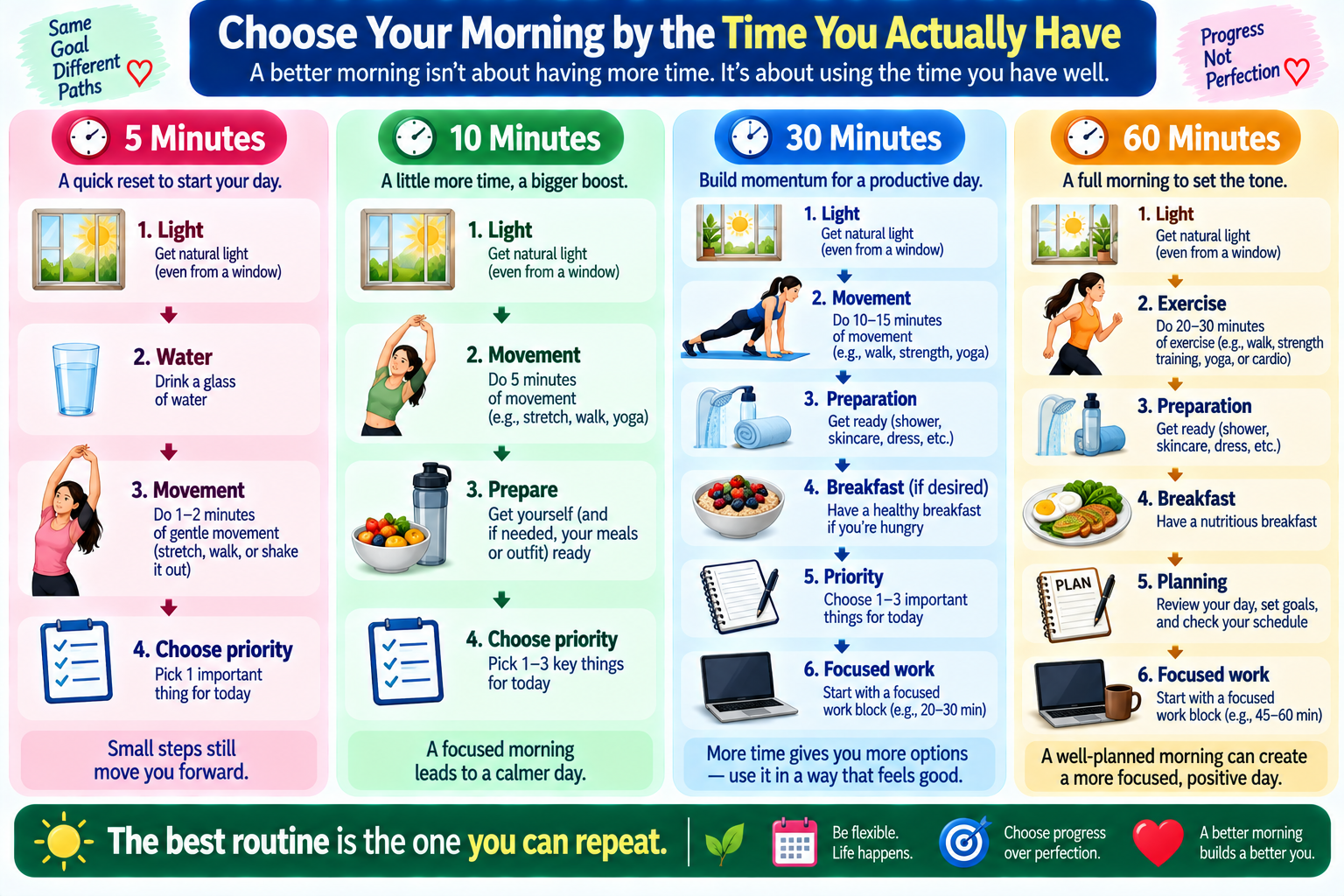
If you have only 30 minutes, try this:
| Time | Habit |
|---|---|
| 0–5 minutes | Get up, wash, and open curtains. |
| 5–10 minutes | Get outdoor light. |
| 10–15 minutes | Gentle movement or short walk |
| 15–20 minutes | Water, hygiene, and simple preparation |
| 20–25 minutes | Identify the day’s priority. |
| 25–30 minutes | Begin the first focused task. |
You can move these steps around.
The objective is not to obey the clock perfectly.
It is to create a predictable sequence that reduces unnecessary decisions.
A 60-Minute Morning Routine
If you have more time, you could use:
| Time | Activity |
|---|---|
| 0–10 min | Wake, hygiene, and daylight |
| 10–25 min | Walk, mobility, yoga, or exercise |
| 25–35 min | Shower and prepare. |
| 35–45 min | Balanced breakfast if desired |
| 45–50 min | Review priorities. |
| 50–60 min | Start focused work. |
You can also use part of this time for meditation, prayer, reading, or journaling if those activities are meaningful to you.
There is no requirement to include every popular morning ritual.
The “Minimum Viable Morning” for Busy Days
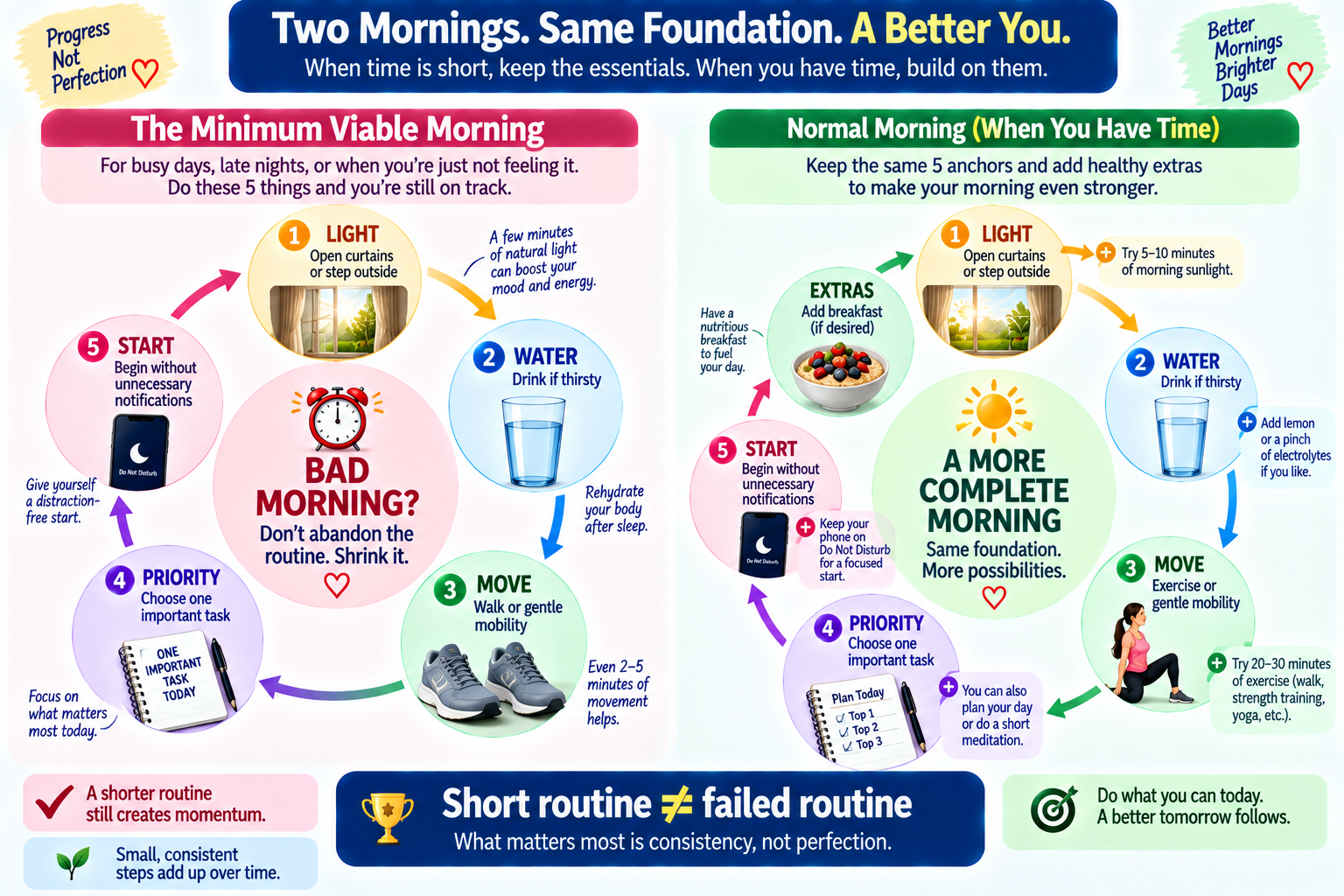
This is one practical idea I would add to most morning-routine guides.
Some mornings will go wrong.
You may wake late.
Your child may need you.
A meeting may start early.
You may be travelling.
Instead of abandoning your routine completely, use a minimum version.
The 5-minute version
Light → water → movement → priority → start
That is enough.
This prevents the all-or-nothing mindset that causes people to abandon routines after one difficult morning.
Morning Routine for People Who Work From Home
Working from home can make mornings deceptively difficult.
There may be no commute to create a natural transition between home and work.
Create your own transition.
For example:
Wake → light → movement → wash → breakfast → short walk → desk
Even a five-minute walk around your neighborhood can create separation between sleep and work.
If possible, avoid beginning work from your bed.
Use a specific workspace.
The objective is to give your brain environmental cues that distinguish rest from focused work.
Morning Routine for Busy Professionals
If you commute, don’t copy a routine designed for somebody who works from home.
Your version might be:
Wake → light → water → brief movement → prepare → healthy breakfast → identify priority → commute
You can also use the commute as a transition period.
For example, you could review your top priority mentally before arriving at work rather than spending the entire journey scrolling through social media.
Morning Routine for Students
Students may benefit from a different structure.
A simple version could be
Wake up → daylight → breakfast if desired → short movement → review today’s most important academic task → study without phone distractions
The aim is to create a predictable beginning rather than attempting an elaborate “5 AM study routine.”
Teenagers also have different circadian timing from adults, so forcing very early wake times can be inappropriate when it cuts into needed sleep. The NIH notes that adolescents naturally tend to have later sleep and wake timing than younger children and many adults. NIH: What Makes You Sleep?
What About Exercise Before Breakfast?
You do not have to exercise fasted to make your morning routine effective.
A 2025 systematic review specifically examined acute exercise with and without breakfast in healthy adults. The available evidence did not show that breakfast consumption clearly changed the cognitive effects of exercise, although the evidence base was small and the studies involved only 70 participants across five studies. PubMed: Exercise With and Without Breakfast and Cognitive Performance
Therefore, choose what feels comfortable and works with your workout.
If you feel weak or dizzy exercising without food, eat first.
If you feel comfortable exercising before breakfast, there is no requirement to eat simply because a productivity article says you should.
Latest Research: What Is Changing in 2026?
One of the most useful developments in recent research is the growing emphasis on lifestyle patterns rather than isolated productivity hacks.
A 2026 meta-analysis examined exercise- and dietary-pattern interventions across 23 randomized controlled trials involving 12,286 participants. The study investigated outcomes including overall cognition, memory, and executive function. PubMed: 2026 Exercise, Dietary Patterns and Neurocognitive Function Meta-Analysis
This supports a broader way of thinking about your morning.
Your productivity is not determined by one habit.
It is influenced by the foundation underneath the routine:
sleep + movement + nutrition + light + attention + consistency
Another important finding comes from the large 2025 umbrella review of exercise research. Across 133 systematic reviews and more than 258,000 participants, exercise was associated with improvements in general cognition, memory, and executive function, with benefits also observed at lower and moderate intensities. PubMed: 2025 Exercise and Cognition Umbrella Review
This is encouraging because it means your morning routine does not have to contain an extreme workout.
A walk counts.
A short mobility session counts.
A manageable exercise routine that you can repeat may be more useful than an intense program you abandon.
Three Morning-Routine Ideas Many Articles Miss
1. Prepare the environment, not just yourself.
Instead of relying entirely on willpower, make the desired behavior easier.
Put your walking shoes near the door.
Keep your journal on your desk.
Place your phone away from your bed.
Prepare breakfast ingredients the night before.
These small environmental changes reduce friction.
2. Create a “decision-free” first five minutes.
Decisions consume attention.
Prepare your first actions in advance.
For example:
Alarm → curtains → bathroom → water → outside
You don’t need to decide what comes next.
The sequence is already established.
3. Have a bad-morning version.
This is one of the most practical improvements you can make.
Your normal routine might take 45 minutes, while your emergency routine can be completed in just five.
That makes the habit resilient.
Common Morning Routine Mistakes
Waking too early
Earlier does not automatically mean better.
If you lose sleep to achieve an earlier wake time, reconsider the schedule.
Copying a celebrity’s routine
Their schedule may depend on circumstances you don’t share.
Build around your actual life.
Making the routine too long
A two-hour routine can become another obligation.
Start with the smallest version that helps.
Checking social media immediately
You may spend your first attention on content chosen by other people.
Protect some early time for your own priorities.
Treating breakfast as mandatory
People have different schedules and dietary preferences. The evidence does not support a single universal productivity breakfast.
Exercising too intensely
A morning routine should support your day, not leave you exhausted before it starts.
Trying everything simultaneously
Adding ten habits at once makes it difficult to know what actually works for you.
Giving up after one missed day
Missing one morning is not failure.
Return to the routine at the next opportunity.
My Personal Experience With Building a Routine
I have found that the most useful routines are the ones I can repeat without constantly negotiating with myself.
When I tried to make a routine too complicated, it became difficult to maintain. A simpler approach worked better: reduce unnecessary phone use, keep a more predictable sleep schedule, get some movement, and decide what needed my attention first.
That experience is personal, not scientific evidence.
The research still needs to guide health claims.
But personal experience can reveal an important practical lesson: the best routine is often the one that creates the least friction while still moving you toward your goals.
A 7-Day Morning Routine Challenge
You don’t need to change everything tomorrow.
Try this instead.
| Day | One change |
|---|---|
| Day 1 | Choose a realistic wake time. |
| Day 2 | Get morning daylight. |
| Day 3 | Add five minutes of movement. |
| Day 4 | Delay unnecessary social media. |
| Day 5 | Write one important task. |
| Day 6 | Prepare something the night before. |
| Day 7 | Combine your easiest habits. |
At the end of the week, ask:
Which habits actually made my morning easier?
Keep those.
Drop the habits that created unnecessary pressure.
How Long Does It Take to See Results?
There is no guaranteed number of days before a morning routine “works.”
Some changes may feel useful immediately, such as having your day planned before work begins.
Other behaviors become easier only after repeated practice.
The habit-formation literature shows substantial variation in how quickly behaviors become automatic. PubMed: Time to Form a Habit Meta-Analysis
Instead of asking:
“How many days until this becomes automatic?”
ask:
“How can I make tomorrow’s routine slightly easier to repeat?”
That question is much more useful.
What If You Are Not a Morning Person?
You do not need to become one.
Productivity is not a personality competition.
Some people naturally prefer later schedules, while others function earlier. What matters is creating a routine that works with your responsibilities and allows adequate sleep.
A healthy routine can also be built around a later start.
The same principles still apply:
wake → light → movement → food if desired → priority → focused work
Only the clock changes.
Key Takeaways
- A productive morning does not require waking at 4 or 5 a.m.
- Protecting sleep should come before adding productivity habits.
- Most adults need at least seven hours of sleep.
- Morning light helps provide an important signal to the circadian system.
- Regular physical activity supports cognitive health.
- A short walk can be a useful part of a productive morning routine.
- You do not need a special “detox” drink after waking.
- Protect some early attention from unnecessary notifications.
- Choose one important task rather than creating an overwhelming list.
- Breakfast can be included if it suits you, but there is no universal productivity breakfast.
- Consistency matters more than creating an impressive routine.
- Build a shorter version for difficult mornings.
- The best morning routine for productivity is one that fits your actual life.
Frequently Asked Questions
What is the best morning routine for productivity?
There is no single routine that is best for everyone. A practical routine usually combines adequate sleep, a consistent wake schedule, morning light, movement, a clear priority, and protected time for focused work.
Do I need to wake up at 5 a.m. to be productive?
No. Productivity does not require a particular wake time. Waking earlier is not useful if it causes you to lose needed sleep.
How long should a morning routine last?
It can be as short as five or ten minutes or extend to an hour. The appropriate length depends on your schedule and what you can maintain consistently.
Should I exercise every morning?
Not necessarily. Regular physical activity is valuable, but it does not have to happen every morning. Your weekly activity pattern matters more than forcing an intense daily workout.
Should I drink water immediately after waking?
You can drink water when you wake if you are thirsty or simply enjoy the habit. There is no need to treat morning water as a special detox or productivity treatment.
Is breakfast necessary for productivity?
Not for everyone. Research on breakfast and cognition is mixed, and there is no universal breakfast composition proven to maximize productivity. PubMed: Breakfast and Cognition in Adults
Should I check my phone in the morning?
You can, but delaying unnecessary notifications and social media may make it easier to protect your attention for your own priorities.
How can I build a morning routine that lasts?
Start with one or two behaviors, connect them to a consistent context, and gradually add habits that genuinely help. Habit formation varies substantially between individuals. PubMed: Health-Behavior Habit Formation Review
Author Note
This article was written by RVLNSV PRASAD with a focus on practical, people-first health and wellness information.
The aim is not to promote an extreme productivity lifestyle. A useful routine should work alongside normal sleep, work, family responsibilities, exercise, and personal preferences.
The research cited in this article was reviewed to avoid presenting popular productivity claims as established medical facts.
Medical Disclaimer
This article provides general educational information and is not a substitute for medical advice, diagnosis, or treatment.
If you have persistent sleep problems, severe daytime sleepiness, dizziness, unexplained fatigue, difficulty exercising, or another ongoing health concern, speak with a qualified healthcare professional.
People with diagnosed sleep disorders or circadian rhythm disorders may require individualized advice rather than a generic morning routine.
Fitness Disclaimer
Physical activity should match your fitness level, health status, and experience.
Start gradually if you have been inactive. Stop exercising if you experience concerning symptoms such as chest pain, severe shortness of breath, fainting, or significant dizziness, and seek appropriate medical care.
If you have a chronic medical condition, recent injury, or other exercise limitation, consider speaking with a healthcare professional before beginning a new exercise program.
Research Methodology
For this article, evidence was reviewed from NIH/NHLBI, CDC, and PubMed-indexed systematic reviews and meta-analyses, with particular attention to sleep, circadian rhythms, light exposure, exercise, cognition, breakfast, and habit formation.
Recent evidence included a 2025 umbrella review of exercise and cognition, a 2026 meta-analysis of exercise and dietary-pattern interventions, a 2026 review of habit-related contextual cues, and recent research examining sleep and screen use.
The article distinguishes between established health evidence and practical productivity suggestions. Where evidence remains limited or mixed, the wording has been intentionally cautious.
Conclusion
A realistic morning routine for productivity does not need to look impressive on social media.
You do not need to wake before sunrise, complete ten rituals, drink a special detox mixture, and exercise for an hour before beginning work.
Start with the foundations.
Sleep enough.
Wake at a time you can maintain.
Get some daylight.
Move your body.
Protect your attention.
Choose one important task.
Then begin.
The strongest routine is not the one that looks perfect on paper. It is the one you can repeat when life is busy, when motivation is low and when your morning does not go according to plan.
That is where productivity becomes practical.
Build a morning that supports your health first, then let productivity grow from that foundation.
Sources
- NIH/NHLBI — Your Sleep/Wake Cycle
- CDC — Sleep and Heart Health
- NIH/NHLBI — Circadian Rhythm Disorders
- NIH/NHLBI — Circadian Rhythm Disorders: Treatment
- PubMed—Exercise, Cognition, Memory, and Executive Function: 2025 Umbrella Review
- PubMed — Exercise With and Without Breakfast and Cognitive Performance
- PubMed — Effects of Breakfast and Breakfast Composition on Cognition in Adults
- PubMed — Breakfast Composition and Cognitive Performance Systematic Review
- PubMed — Time to Form a Habit: Systematic Review and Meta-Analysis
- PubMed — Exercise and Mental Health: Umbrella Review
Related articles
- Tips for Building Healthy Habits and Sticking to Them
- 13 Effective Tips on How to Get Sleep Quickly
- Full Abs Workout at Home: Daily Routine to See Results in 30 Days
- 8 Effective Habits to Boost Mental Clarity and Focus
- 10 Best Morning Health Propensities to Boost Your Vitality and Productivity
- Category Healthy Habits
- home
Post Views: 2,225











[…] Best Morning Routine for Productivity: Unlock Your Full Potential […]
[…] Best Morning Routine for Productivity: Unlock Your Full Potential […]
[…] Best Morning Routine for Productivity: Unlock Your Full Potential […]